
Cryptocurrency Quantitative Trading: A Beginner's Guide
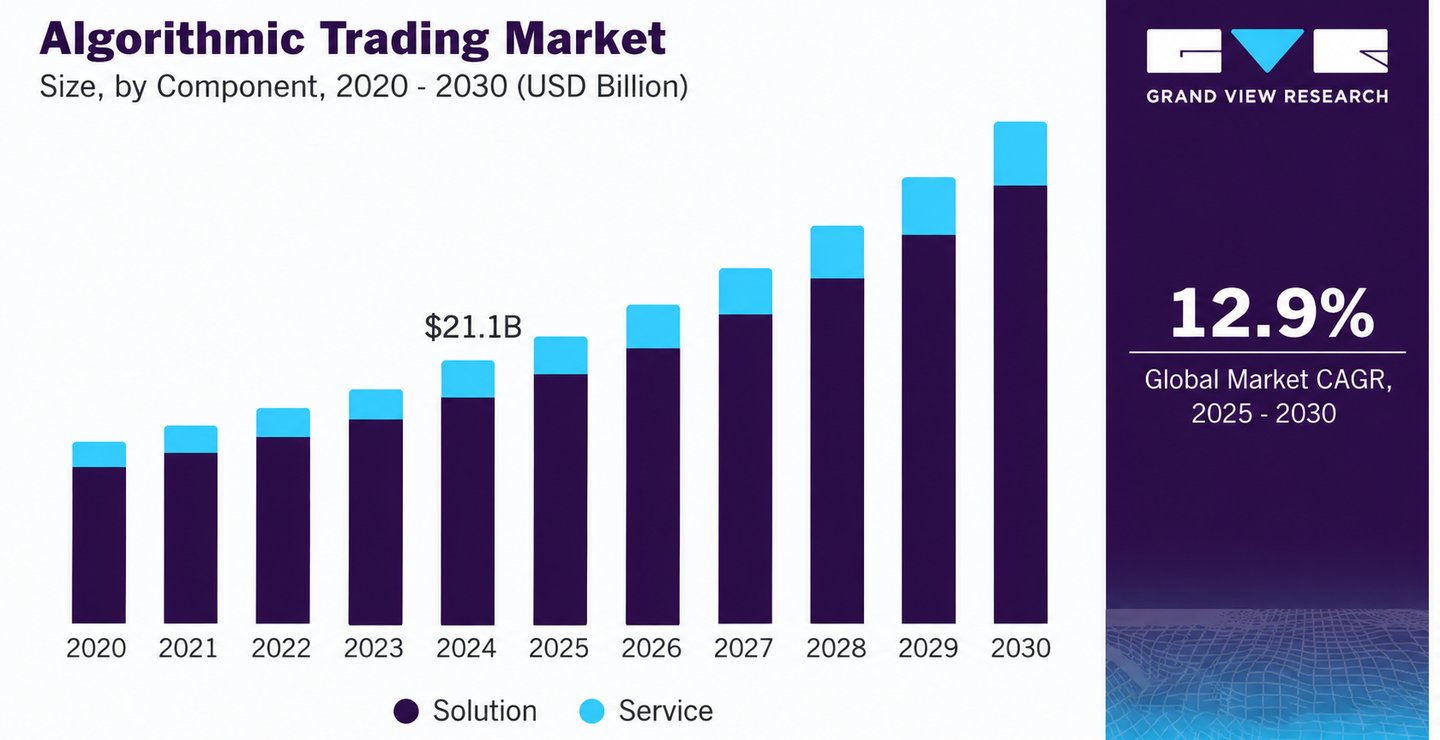
Crypto quantitative trading is rapidly transforming the digital asset landscape, offering a data-driven approach to navigating the volatile cryptocurrency market. The global algorithmic trading market, including quantitative strategies, was valued at $21.06 billion as of 2024 and is projected to grow at a compound annual growth rate (CAGR) of 12.9% from 2025 to 2030. This surge reflects the increasing reliance on sophisticated algorithms and mathematical models for precise and rapid trade execution.
This article delves into the fundamentals of crypto quantitative trading, exploring its key components, common strategies, advantages, and risks. We'll also illustrate practical applications through a hypothetical case study involving the CET token. Whether you're a novice investor or an experienced trader, understanding the mechanisms of quantitative trading can provide valuable insights into the ever-evolving world of cryptocurrency investment.
What is crypto quantitative trading?
Crypto quantitative trading refers to the systematic execution of cryptocurrency trades based on mathematical, statistical, and computational models. This approach does not rely on intuition or emotional decision-making, but instead uses data-driven algorithms to identify opportunities, assess risks, and execute trades with high speed and accuracy.
History and Evolution
Quantitative trading originated in traditional financial markets and was primarily used by institutional participants. Over time, this approach gained traction in the crypto space due to the digital nature of assets and the abundance of historical data. The 24/7 operation of crypto markets further fueled the rise of algorithmic systems, making quantitative trading particularly effective in this area.
The shift from discretionary to data-driven transactions
Traditional discretionary trading involves human judgment in making buy and sell decisions, often based on news, technical patterns, or market sentiment. In contrast, quantitative trading eliminates human bias by strictly adhering to predefined rules and statistical models. This approach enhances objectivity, which is particularly important in the volatile and emotionally driven crypto markets.
Core Concepts
At the heart of crypto quantitative trading is using vast amounts of data—including price history, trading volume trends, and order book dynamics—to predict future price movements. These insights are translated into algorithms that automatically execute trades when specific conditions are met, maximizing efficiency and minimizing human intervention.
Key components of crypto quantitative trading
Understanding crypto quantitative trading requires familiarity with its building blocks. Each component plays a crucial role in developing a robust, efficient, and profitable trading system.
Data collection and processing
Data is the lifeblood of quantitative trading. Traders collect historical and real-time data, such as price movements, trading volume, volatility indices, and blockchain metrics. This data is then cleaned and structured for use in algorithms. The more comprehensive and higher-quality the data, the more accurate the model's predictions tend to be.
Algorithm Development
Once the data is ready, traders create algorithms based on specific mathematical models. These can include statistical techniques such as linear regression, time series analysis, or machine learning methods. The goal is to identify profitable patterns and translate them into actionable trading rules.
Backtesting strategy
Before deploying a strategy, traders backtest it using historical data. This step helps evaluate the algorithm's past performance, revealing its potential profitability and exposing weaknesses. A well-backtested model increases confidence, but future success is not guaranteed due to changing market conditions.
Execution System
Execution is where theory meets reality. Traders use execution systems to automatically place orders on various exchanges. These systems are designed for speed, accuracy, and minimal slippage. Factors such as latency, order routing, and exchange liquidity significantly impact execution quality.
Common strategies in crypto quantitative trading
Quantitative strategies vary in complexity and purpose. Here are some of the most commonly used strategies in the crypto market:
Mean Regression
This strategy assumes that asset prices will revert to their historical averages over time. Traders identify overbought or oversold conditions and expect a reversion to the mean to trade. For example, if Bitcoin is trading significantly above its 30-day average, a mean reversion strategy might short the position, anticipating a correction.
Momentum Trading
Momentum strategies capitalize on the continuation of existing trends. The algorithm detects upward or downward price momentum and enters trades in the direction of the trend. In the crypto market, trends can persist due to herding behavior, making momentum trading particularly effective.
Statistical arbitrage
Statistical arbitrage involves exploiting price inefficiencies between related cryptocurrency pairs. For example, if Ethereum and a certain DeFi token have historically moved in tandem but are temporarily diverging, a statistical arbitrage strategy might go long on one and short on the other, expecting the correlation to return to normal.
Machine learning models
Advanced traders use machine learning to identify patterns that traditional models might miss. These strategies learn from past data to predict future price movements. While powerful, they require large datasets, significant computational resources, and continuous model tuning to remain effective.
Advantages and risks
While crypto quantitative trading offers clear advantages, it also presents challenges. Understanding both sides helps traders make informed decisions and manage expectations.
Advantages
Emotionless trading:
Quantitative systems eliminate human emotions such as fear and greed, which often lead to irrational decisions in discretionary trading. The algorithm strictly adheres to data and logic.
Speed and efficiency:
These systems can process and respond to market data in milliseconds—far faster than any human. This speed is particularly advantageous in the rapidly changing world of crypto trading.
Backtesting capability:
Before taking real-money risks, traders can use historical data to test their strategies to identify strengths, weaknesses, and expected returns under different conditions.
Scalability:
Quantitative strategies can manage multiple trades and monitor numerous assets simultaneously, making them ideal for portfolio diversification and risk mitigation.
Risks and limitations
Model overfitting:
Some algorithms are too closely tied to historical data and fail when faced with new market conditions. This leads to poor actual performance.
Technical malfunction:
Faults, errors, or internet outages can lead to erroneous transaction executions or financial losses. Robust infrastructure and fault protection measures are essential.
Regulatory uncertainty:
The legal environment for crypto-algorithm trading is still evolving. Regulatory changes may affect the viability of strategies or create compliance challenges.
Market structure risks:
The crypto market is fragmented across various exchanges, with varying liquidity and order execution quality. These inconsistencies can impact strategy performance, particularly in statistical arbitrage or high-frequency trading.
Case Study: Assuming a CET token trading scenario
To combine theory with practice, let’s consider a hypothetical quantitative trading scenario involving CoinEx’s native token, CET.
Scene settings
Imagine a trader analyzing the CET over the past 180 days . The token exhibits cyclical short-term volatility spikes followed by rapid recovery, making it a candidate for a mean-reversion strategy.
Strategy Development
Traders built an algorithm to calculate the 10-day and 30-day moving averages of the CET (Central Exchange Rate). When the 10-day moving average deviates from the 30-day moving average by more than 5%, the system places a trade, anticipating a price reversion. The system integrates stop-loss and take-profit levels to manage risk and lock in profits.
Backtesting results
Historical data from the third quarter of 2024 to the first quarter of 2025 was used:
Win rate: 63%
Average return per trade: 1.8%
Maximum drawdown: 5.6%
Sharp ratio: 1.3
The results indicate that this is a strategy with moderate profitability and acceptable risk metrics, suitable for deployment and careful monitoring in real-world market environments.
Lessons learned
Volatility patterns are important: identifying recurring price behaviors can reveal hidden opportunities.
Backtesting to validate assumptions: Always test before live trading to avoid costly mistakes.
Risk control is crucial: even a powerful strategy can underperform without proper stop-loss settings and position management.
Introduction to Crypto Quantitative Trading
If you are interested in exploring crypto quantitative trading, there are a few practical steps to get started effectively and safely.
Educational resources
First, establish a solid foundation in quantitative finance, programming, and data analysis. Recommended resources include:
CoinEx Academy: CoinEx Academy is a dedicated section containing many guides and tutorials like this one.
Books: Ernest Chan's "Algorithmic Trading" and Yves Hilpisch's "Python for Financial Applications" .
Online courses: Platforms such as Coursera and Udemy offer courses in algorithmic trading and machine learning, from beginner to advanced levels.
Academic papers and blogs: Websites such as arXiv and Medium offer insights from quantitative professionals and researchers.
Tools and Platforms
Obtaining the right tools is crucial for strategy development and execution:
Programming Language: Python is the most popular choice because it has a rich library of languages such as Pandas, NumPy, and Scikit-learn.
Backtesting libraries: Tools such as Backtrader, QuantConnect, and PyAlgoTrade can help simulate strategies on historical data.
Trading Platform: Although CoinEx does not currently offer a native algorithmic trading API, you can integrate strategies with other platforms and manage manual execution on CoinEx.
Best Practices
Start small: Test your strategy in real-time market conditions by first engaging in simulated trading or using a small amount of capital.
Continuous iteration: The market is constantly evolving—so should your algorithm. Regularly review performance and adjust the model accordingly.
Prioritize risk management: Use stop-loss orders, position sizing rules, and exposure limits to control downside risk.
Record everything: Keeping trading logs, model changes, and market condition records helps you refine your methods over time.
Final Reflection: The Combination of Data and Discipline in the Crypto Market
Crypto quantitative trading is more than just a buzzword—it's a transformative approach that blends mathematics, computer science, and market intuition. By leveraging data and algorithms, traders can eliminate emotional biases and make faster, more informed decisions in a market known for its volatility.
As the crypto market continues to mature, those who can leverage the power of data will be well-positioned on this dynamic frontier of finance.
Subscribe to our newsletter